
BubbleFect® Data
Customer data, provided with permission to share
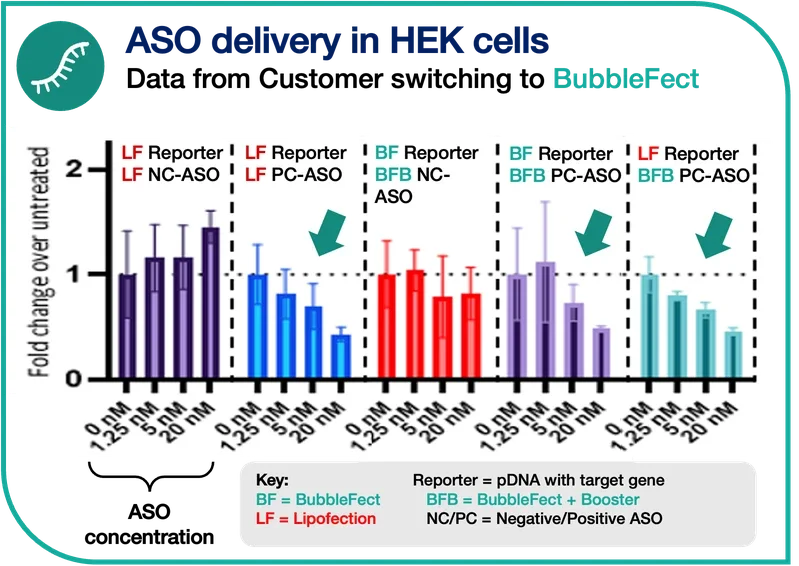
ASO delivery in HEK cells
Antisense oligonucleotides (ASOs) are a powerful class of nucleic acid therapeutics — but getting them reliably into cells remains a significant challenge. BubbleFect rises to that challenge.
In head-to-head testing against Lipofection, one of the most widely used transfection reagents, BubbleFect with Booster (BFB) demonstrates clear, dose-dependent knockdown of the target gene using a positive control ASO (PC-ASO) across concentrations from 1.25 nM to 20 nM. Reporter expression is reduced below baseline in a concentration-dependent manner, confirming successful intracellular delivery and functional activity.
Specificity is also maintained — the negative control ASO (NC-ASO) shows no knockdown effect, exactly as expected.
BubbleFect matches and in several conditions outperforms Lipofection, while offering a non-lipid, non-viral alternative that is gentler on cells, simpler to prepare, and free from the cytotoxicity and temperature sensitivity concerns associated with lipid-based reagents.
Whether you are working in gene silencing, splice switching, or RNA-targeting research, BubbleFect delivers.
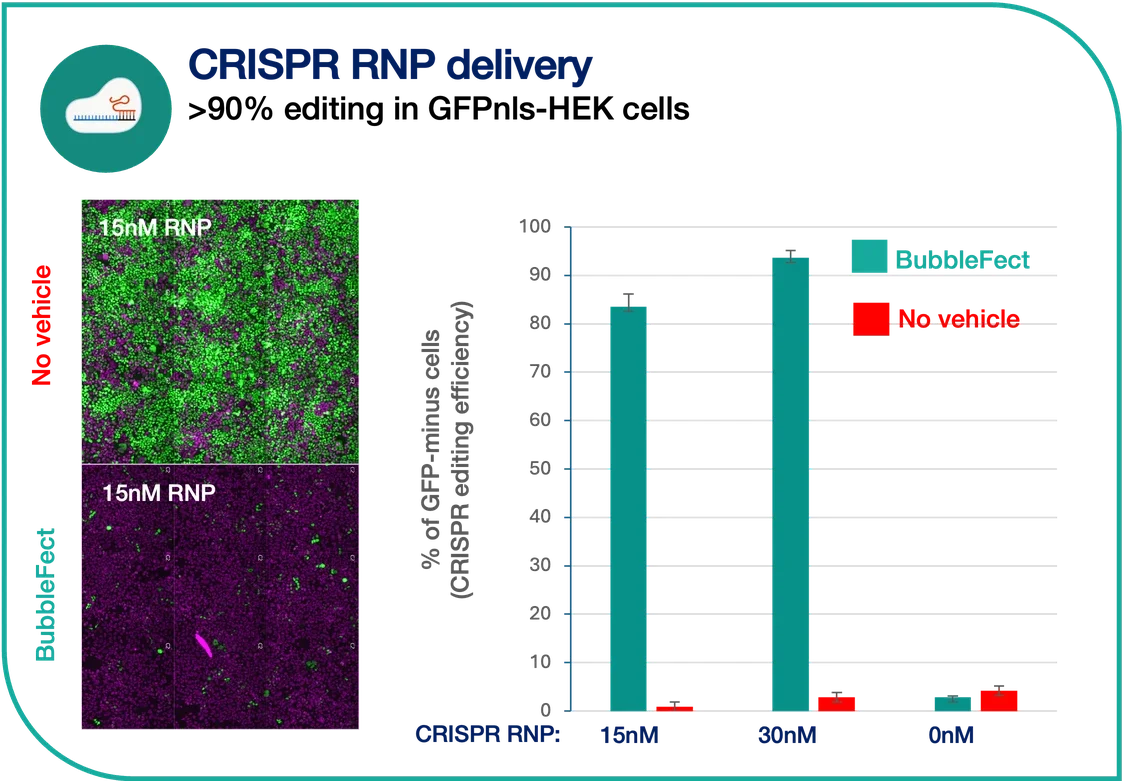
CRISPR RNP delivery in GFPnls-HEK cells
CRISPR-based genome editing depends on one thing above all else — getting the RNP complex into the cell efficiently. BubbleFect makes that happen.
In this experiment, BubbleFect was used to deliver CRISPR RNPs into GFP-expressing cells, with editing efficiency measured by the percentage of GFP-minus cells — cells where the GFP gene has been successfully knocked out. The results are striking.
At just 15 nM RNP, BubbleFect achieves over 80% editing efficiency. At 30 nM, this rises to over 90%. In contrast, the no-vehicle control — RNP delivered without any transfection reagent — achieves less than 5% at both concentrations, demonstrating that efficient intracellular delivery is the critical factor, not the RNP itself.
The fluorescence microscopy images tell the same story visually. Without BubbleFect, cells remain predominantly green — GFP expression is intact. With BubbleFect, the field is almost entirely magenta, confirming near-complete knockout of GFP expression across the cell population.
At the 0 nM RNP control, both conditions show minimal GFP loss, confirming that BubbleFect alone has no non-specific effect on gene expression.
High-efficiency CRISPR delivery. No viral vectors. No lipids. Just results.
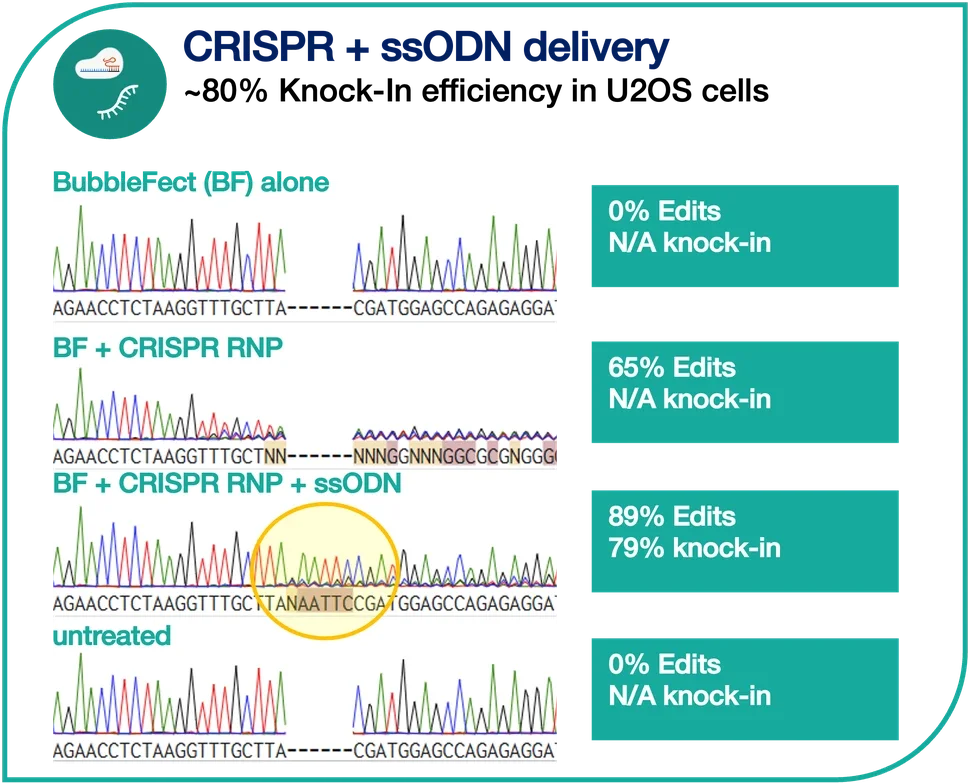
CRISPR + ssODN delivery in U2OS cells
Gene knockout is powerful. Precise gene correction and knock-in is transformative. BubbleFect enables both.
This data demonstrates BubbleFect's ability to co-deliver CRISPR RNP and a single-stranded oligodeoxynucleotide (ssODN) donor template — enabling not just genome editing but precise sequence knock-in via homology-directed repair (HDR).
The Sanger sequencing results across four conditions tell a clear story:
BubbleFect alone produces no edits and no knock-in, confirming that BubbleFect itself has no effect on the genome — a clean, inert delivery vehicle.
BubbleFect + CRISPR RNP achieves 65% editing efficiency, evidenced by the characteristic mixed sequencing signal downstream of the cut site — confirming successful RNP delivery and Cas9-mediated cleavage.
BubbleFect + CRISPR RNP + ssODN takes this further, achieving 89% total editing efficiency and — critically — 79% precise knock-in of the target sequence. The Sanger trace shows the clean insertion of the intended sequence (highlighted), confirmed by the resolution of ambiguous signal into a clean, readable read. This level of HDR efficiency is exceptional and demonstrates BubbleFect's ability to co-deliver multiple cargo types simultaneously without compromising performance.
Untreated cells show no editing whatsoever, as expected.
From simple knockout to precise sequence correction — BubbleFect delivers the full power of CRISPR editing.
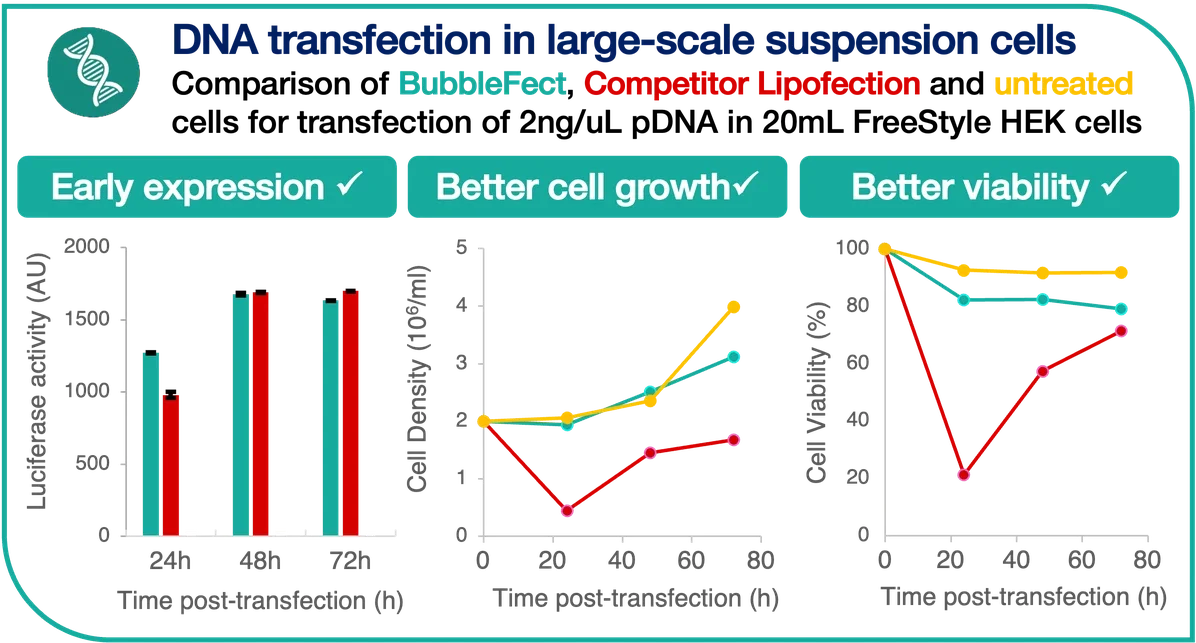
DNA delivery in suspension cells
Scaling up transfection in suspension cells is one of the most demanding challenges in bioproduction and cell therapy manufacturing. Efficiency matters — but so does keeping cells alive and growing. BubbleFect delivers on both.
In direct head-to-head comparison with a competitor lipofection reagent across three key metrics, BubbleFect consistently outperforms.
Early Expression: At 24 hours post-transfection, BubbleFect already achieves high luciferase reporter activity — significantly ahead of the lipofection competitor, which shows considerably lower expression at the same timepoint. By 48 and 72 hours both reach comparable peak expression, but BubbleFect's early expression advantage means faster results and shorter experimental timelines.
Better Cell Growth: The impact on cell health tells an even clearer story. Following transfection, the lipofection competitor causes a dramatic drop in cell density — falling to below 0.2 × 10⁶/ml at 24 hours before slowly recovering. BubbleFect-treated cells maintain density throughout, tracking closely with the untreated control and continuing to grow to over 3 × 10⁶/ml by 72 hours. Cells transfected with BubbleFect simply keep growing.
Better Viability: The viability data reinforces this picture. Lipofection drives cell viability down to around 20% at 24 hours — a severe cytotoxic hit from which cells only partially recover to ~70% by 72 hours. BubbleFect maintains viability above 80% throughout the entire time course, closely mirroring the untreated control.
The same transfection efficiency. Earlier expression. Healthier cells. At scale.
mRNA delivery in hiPSCs
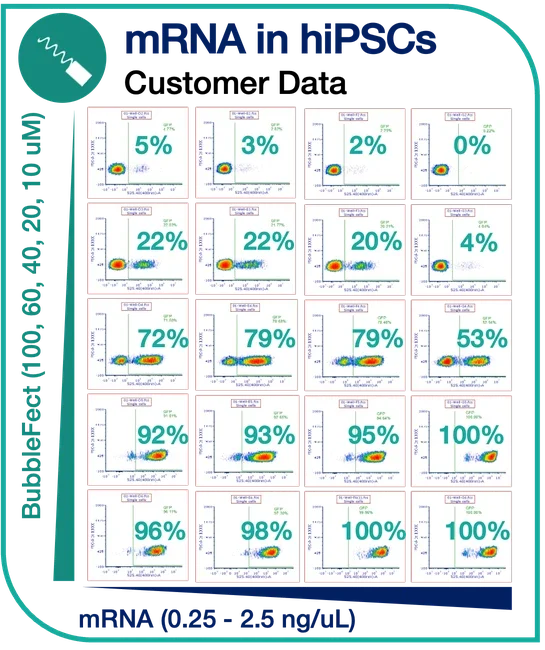
Human induced pluripotent stem cells (hiPSCs) are among the most challenging cell types to transfect — and among the most valuable. Successfully delivering mRNA into hiPSCs opens the door to disease modelling, cell reprogramming, and next-generation cell therapies. BubbleFect meets that challenge head on.
This flow cytometry data shows GFP mRNA delivery across a matrix of BubbleFect concentrations (100, 60, 40, and 20 µM) and increasing mRNA doses, measured as the percentage of GFP-positive cells. The progression is remarkable.
At lower BubbleFect and mRNA concentrations, efficiency begins modestly — but then there is an inflection point to higher transfection efficiencies and expression levels that corresponds to the phase-transition event in the formation of the transfection Bubbles (liquid-liquid phase separation). This is a cooperative outcome with the cargo, and thus we recommend a titration matrix of cargo concentration to BubbleFect concentration, to begin optimization to your cell type, after which, you have a reliable and tunable formulation for subsequent experiments. At optimised concentrations, BubbleFect achieves 95%, 98%, 100% and 100% transfection efficiency, effectively delivering mRNA into the entire cell population. Even at intermediate conditions, efficiencies of 72–93% are consistently achieved across replicates, demonstrating both potency and reproducibility.
This dose-responsive behaviour gives researchers precise control over their transfection conditions — critical when working with precious, hard-to-expand stem cell populations where consistency and cell health are non-negotiable.
Near-complete mRNA delivery into one of the hardest cell types to transfect. No lipids. No viral vectors. Just BubbleFect.
Protein delivery in cancer cell lines
Delivering functional proteins directly into cells is one of the most challenging frontiers in life sciences research — and one of the most exciting. BubbleFect makes it possible, efficiently and gently, across multiple cancer cell lines.
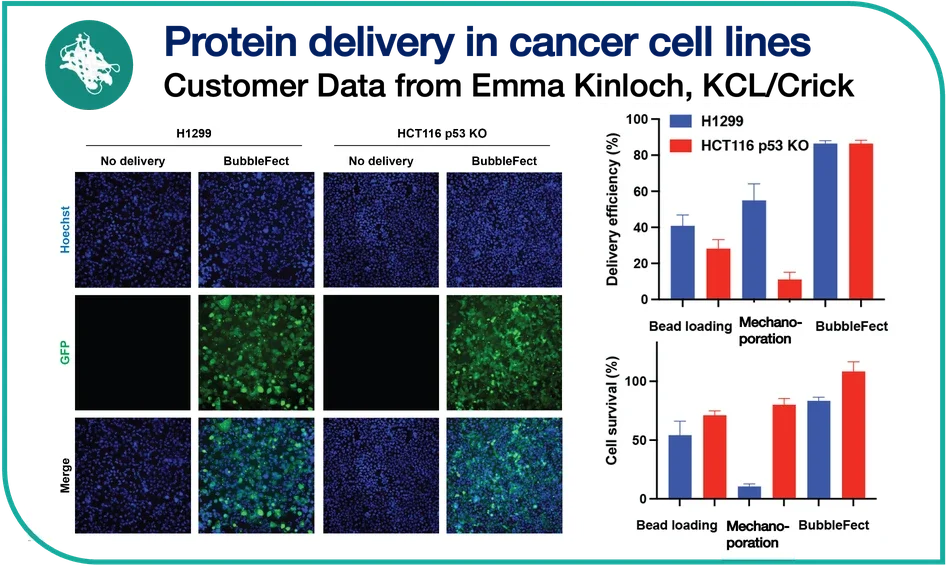
This data shows GFP protein delivery into two difficult cancer cell models — H1299 (lung carcinoma) and HCT116 p53 KO (colorectal cancer knockout line) — comparing BubbleFect against two established physical delivery methods: bead loading and mechanoporation.
The fluorescence microscopy images speak for themselves. Without delivery, cells show no GFP signal. With BubbleFect, both H1299 and HCT116 p53 KO cells show strong, widespread intracellular GFP fluorescence — confirming successful protein delivery across the cell population.
Delivery Efficiency: BubbleFect achieves approximately 85% delivery efficiency in both cell lines — significantly outperforming bead loading (~40% in H1299, ~28% in HCT116) and mechanoporation (~55% in H1299, ~11% in HCT116). Critically, BubbleFect delivers this consistently across both cell lines, demonstrating versatility across different cancer cell models.
Cell Survival Where BubbleFect truly differentiates itself is cell survival. Mechanoporation, despite moderate delivery efficiency, is highly damaging — dropping cell survival to below 10% in H1299 cells. Bead loading fares better but still compromises viability. BubbleFect maintains cell survival at approximately 90% in H1299 and exceeds 100% relative survival in HCT116 p53 KO — meaning cells continue to proliferate normally following treatment.
High efficiency. High viability. Across challenging cancer cell models.
BubbleFect delivers proteins where other methods fall short — without the collateral damage.
A new phase in cell delivery
From