

For BioProcessing
Higher yield, sooner, from half the DNA in suspension cells
A peptide-based liquid droplet reagent for HEK293 suspension culture. Mix it with your DNA, add it straight to the culture and harvest earlier.
For research use only. Planning AAV, CHO or GMP work? Talk to us.
50-60%
Less DNA cargo than common transfection reagents
(10 µg against 20-25 µg)
48h
BubbleFect expression at 48 hours beat benchmark reagents at 72 hours
0 min
Pre-incubation, and no time limit for transferring the mix to your cells
What BubbleFect is
A simpler workflow for suspension culture
BubbleFect is a non-viral reagent made of designed peptides. It forms liquid droplets around your DNA. RNA or protein cargo and carries it into cells, with no lipids and no viral vector.
Step 1
Mix
Combine BubbleFect, water and your plasmid DNA. The mix is stable: no complexes to form, no pre-incubation and no time limit before use.
Step 2
Add
Add the mix directly to the culture, up to 10% of the volume. The droplets form instantly on contact with the medium.
Step 3
Harvest
Harvest from 48 hours. In our HEK293- F data, expression at 48 hours was higher than the benchmark reagents at 72 hours.
Why is suits BioProcessing
Better output, a ligher workflow and a route to scale
Higher
yield
Higher reporter expression than two benchmark reagents at 24, 48 and 72 hours in HEK293-F suspension cells.
Comparable viability
Cell density and viability stayed comparable to common transfection reagents in the same experiment.
Faster expression
Protein is detectable and higher earlier, so you can harvest as early as 48hrs and shorten each run.
Flexible handling
No time pressure between mixing and adding, and batches that can be frozen or lyophilised for repeat runs.
Less
DNA
10 µg of plasmid instead of 20-25 µg, so 50-60% less DNA per culture, with higher expression.
Biodegradable, GMP pathway
A peptide-based reagent that is biodegradable, with a pathway towards GMP manufacturing for process use.
THE DATA
HEK293-F suspension: more protein, sooner, from less DNA
Secreted Gaussia luciferase reporter, compared with two common benchmark reagents (FS-MAX and Fecto-VIR) used as the manufacturers recommend.
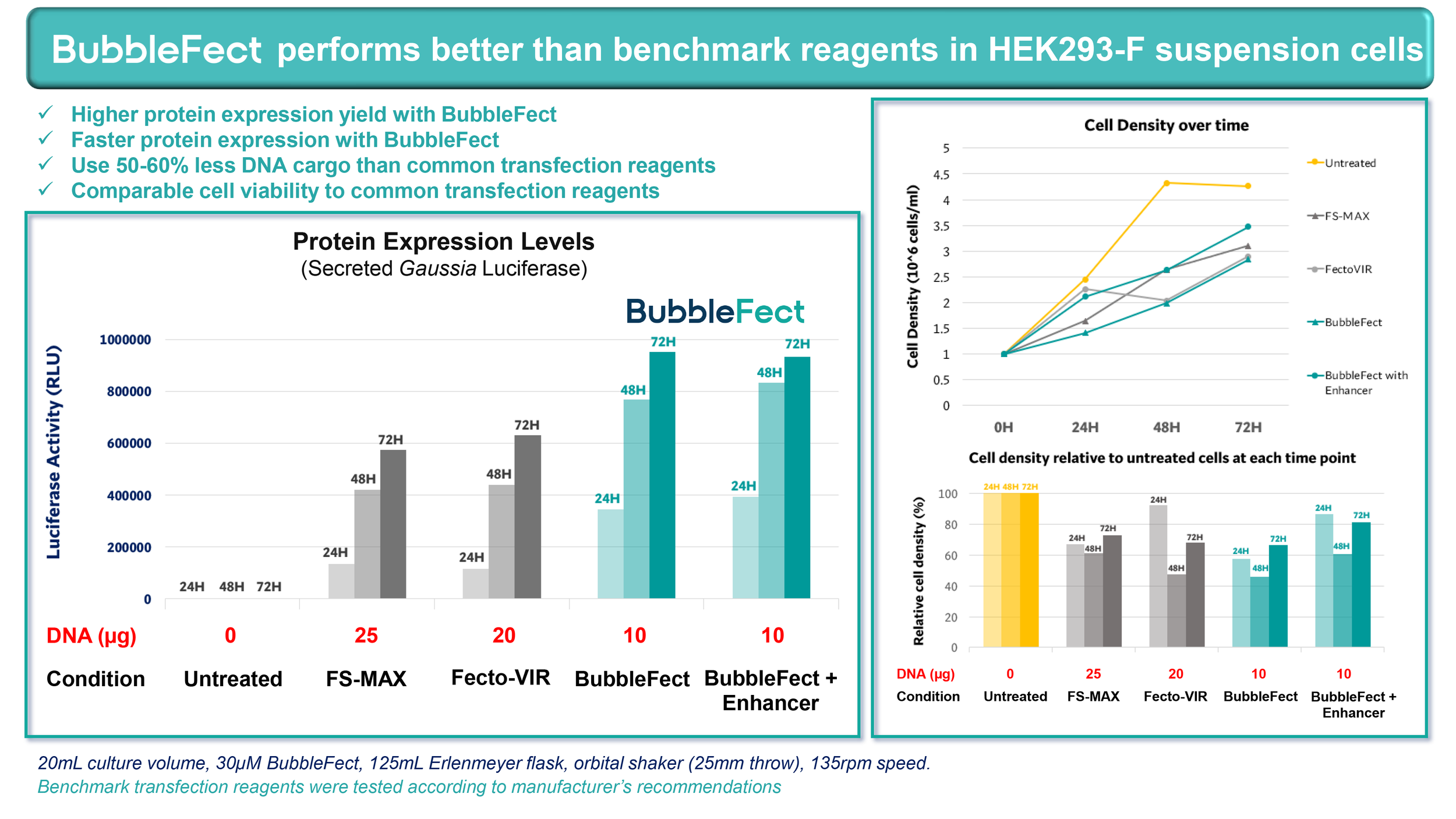
20 ml culture, 30 µM BubbleFect, 125 ml Erlenmeyer flask, orbital shaker (25 mm throw) at 135 rpm. Source: BubbleFect data deck.
Beyond Data: Platform breadth from our data page
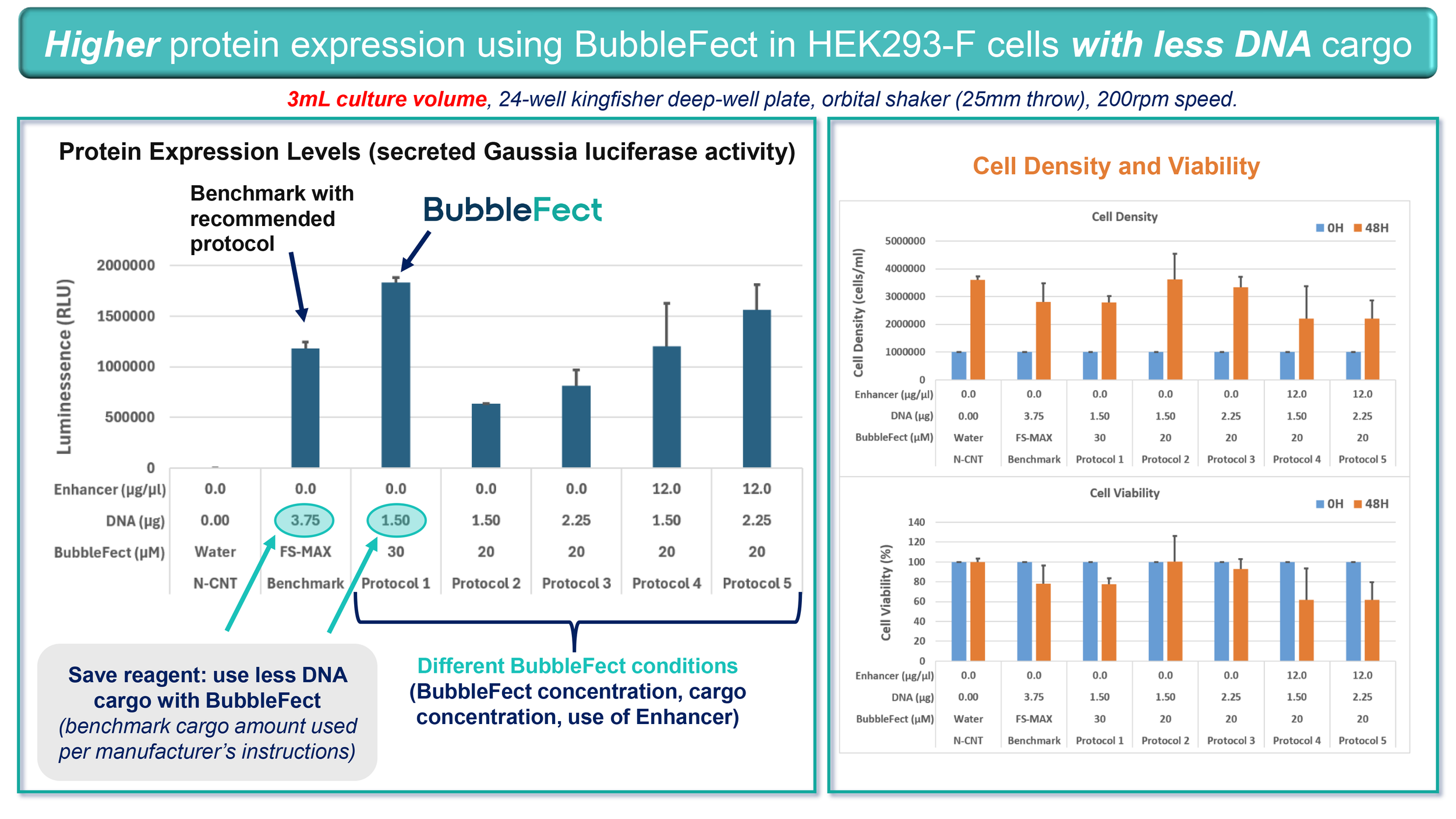
3 mL culture in 24-well deep-well plates at 200 rpm: 1.5 µg of DNA with BubbleFect against 3.75 µg with the benchmark reagent.
These results use a reporter plasmid. We do not yet have published AAV titre or CHO data, so if that is your process, talk to us about a trial. See all the data
Above 80% viability
in large-scale Freestyle HEK suspension, while a lipofection reagent fell to about 20% at 24 hours (separate experiment).
Over 90% editing
CRISPR RNP delivery at 30 nM in GFPnls-HEK cells.
Up to 100% delivery
of mRNA into hiPSCs at optimised concentrations.
About 85% delivery
of protein into H1299 and HCT116 cancer cell lines, with cell survival of about 90% or more.
What researchers say
Rated 4 or 5 out of 5 for performance
PERFORMANCE 5/5
"Almost 100% delivery with no effect on cell viability"
Emma Kinloch, Francis Crick Institute. Protein delivery into HCT116 and H1299 cancer cells, replacing bead loading and cell squeezing.
WORKFLOW FIT 5/5
Best balance of delivery and survival at 40-60 µM BubbleFect and 0.5-1 ng/µ1 plasmid
Wellcome Sanger Institute. Plasmid HDR library delivery in HAP1 cells, and they would use BubbleFect again.
PERFORMANCE 4/5
"Low toxicity was good to see, even transfection so all in all I was happy with the results"
Pharma team, target identification. Labelled protein, RNP and plasmid in Huh? and HCT-116 cells, compared with Lipofectamine and electroporation.
PERFORMANCE 5/5
Much better than ProtiFect for protein delivery into SH-SYSY cells
Academic neuroscience lab. A direct comparison of delivery efficiency, and they would use BubbleFect again.
The science
Phase separation, not lipids
Inside every cell, proteins and nucleic acids gather into membrane-less droplets called biomolecular condensates. They form and dissolve within seconds, and help cells control gene expression and stress responses. The process is called liquid-liquid phase separation, a bit like oil separating from water.
BubbleFect uses designed peptides that self-assemble with your cargo into water-based micro-droplets the moment you mix them. Cells absorb the droplets and release the cargo inside.
There are no lipids, no viral vectors and no electroporation. The platform is non-viral and stable at room temperature, and it works with DNA, mRNA, CRISPR RNPs and proteins.
Read more about the technology
1. Mix
BubbleFect peptide and your cargo
2. Droplets form
Cargo concentrates inside liquid condensates
2. Cells take them up
Droplets are absorbed and release the cargo inside
Who is using it
104 organisations in 19 countries are already using BubbleFect
Alpha, Beta and customer contacts, October 2026. Percentages are of contacts with a recorded cargo or cell type.
19
countries, with most users in the UK and US
104
organisations in the Alpha, Beta and customer community
200
researchers, from academic labs to biotech and global pharma
Cargo in use
Cell types in use
Try BubbleFect in your suspension process
Order a kit from £130, or talk to our team about a trial in your AAV, antibody or protein production workflow.
For research use only. For GMP, manufacturing or partnership enquiries, please contact us.